VMSA-2026-0011: 23 VMware Vulnerabilities, Critical Fixes, and What You Actually Need to Patch
If you were hoping to spend Thanksgiving week thinking about anything other than VMware patches, I have some good news and some less-good news. The good news is that many of the fixes you need are already available, and some of you installed part of the solution last week. The less-good news is that a patched vCenter is not necessarily a patched VMware environment.
On November 24, 2026, Broadcom released VMSA-2026-0011, covering 23 vulnerabilities across VMware’s management plane, hypervisors, guest tools, desktop virtualization and Avi Load Balancer. Four CVEs reach critical severity on at least one affected product; three reach CVSS 9.8. This follows last Thursday’s security announcements and coincides with the general availability of VMware Cloud Foundation 9.1.2.
The short version: prioritize the new vCenter and ESX fixes; verify the exact component versions you already installed; include guest tools, vSAN witnesses and separately managed products in your inventory; and keep the unresolved advisories on your risk register. The release number alone is not your remediation report.
The vulnerabilities that should get your attention first
Start with CVE-2026-123903, the 9.8-rated vCenter authentication bypass. The directory service is a particularly important boundary in a virtualized infrastructure because it participates in the identity system that governs management access. A vulnerability that can allow unauthorized access without a valid account deserves immediate attention even when the management network is not internet-facing.
This is not the same vulnerability as CVE-2026-123890 disclosed on November 19. The official FAQ identifies them as distinct issues. The exploitation evidence discussed in our earlier vCenter zero-day article must not be automatically attributed to the new CVE. Today’s advisory reports private disclosure, not a confirmed campaign exploiting these new issues. That is not proof of absence of exploitation. Do not wait for an exploitation report before addressing a critical exposure.
The other two 9.8 issues, CVE-2026-123910 and CVE-2026-123911, affect the ESX I/O filter service. They matter because access to a guest virtual machine is not a prerequisite: the security boundary at risk is the host itself. A host is a shared failure domain, so the impact of compromised host integrity is potentially much broader than an incident confined to one workload. Treat access to the ESX management network as privileged, even when it originates inside your own organization.
The fourth critical CVE is a useful reminder that severity depends on the product. CVE-2026-123912, involving the virtual USB controller, scores 9.3 for Workstation and Fusion and 8.4 for ESX. The desktop hypervisor and the ESX VMX sandbox impose different boundaries. The advisory matrix gives ESX a score of 8.4; the accompanying FAQ lists 8.5, so this article follows the primary advisory. CVE-2026-123913 separately concerns elevation from the VMX process; these are different weaknesses, not a demonstrated exploit chain. Update desktop hypervisors as well as your data center.
What exactly do I need to patch?
The following is a component-level summary of the November 24 response matrix, rather than a claim that every product in a bundle is automatically fixed. Match each installed build to its own applicable row. The table deliberately separates 9.0.x and 9.1.x because their ESX coverage is different.
| Deployment | vCenter | ESX |
|---|---|---|
| VCF/VVF 9.1.x | 9.1.2 | 9.1.2.0 build 25946735 |
| VCF/VVF 9.0.x | 9.0.2.0300 (all seven vCenter CVEs) | ESXi-9.0.2.0200-25953133 covers five of seven CVEs; CVE-2026-123914 (6.7) and CVE-2026-123915 (6.3) remain patch pending, without a listed workaround |
| Standalone 8.0 | 8.0 U3m / 25934264 | 8.0 U3m build 25926933; KB463535 interim mitigation for CVE-2026-123910/123911 |
| VCF 5.x | 8.0 U3m / 25934264 (VCF 5.2.5 component) | 8.0 U3m / 25926933; verify installed host build; use the applicable lifecycle method in KB88287 |
| Standalone 7.0 | Contact Broadcom if extended support contract | Contact Broadcom if extended support contract |
| Telco Cloud Platform / Infrastructure | 8.0 U3m; KB463501 (TCP 3.0, 4.x, 5.0.x, 5.1.x, 5.2; TCI 3.0) | 8.0 U3m / 25926933; KB463501 (TCP 5.0.x, 5.1.x only in ESX row) |
Staying on VCF or VVF 9.0.x? The November 24 express patches
The November 24 updates for the 9.0.x branch are component express patches, not a new full-stack VCF 9.0.2 release. vCenter 9.0.2.0300 supersedes last week’s vCenter 9.0.2.0200 and addresses all seven vCenter CVEs in this advisory. On the 9.0.x branch, ESX 9.0.2.0200 covers five of the seven listed host vulnerabilities, including both 9.8 issues. The two remaining issues are CVE-2026-123914 (6.7) and CVE-2026-123915 (6.3). Broadcom’s specific matrix lists both as patch pending with no workaround. The FAQ’s general description of the express patch should be read together with those rows. Apply the available critical fixes promptly; track the residual exposure separately.
Both remaining vulnerabilities concern host security controls, including protected configuration and signature verification. Lower scores reflect different attack prerequisites; they do not make persistence or tampering irrelevant to a compromised host. For customers who can move to 9.1.2, its host release covers all seven. For those who cannot, the 9.0.x express patches still provide meaningful immediate risk reduction.
I patched last Thursday. Do I really have to patch again?
It depends on what you patched. The FAQ (Q8, Q9 and Q21) explains that vCenter 8.0 U3m already contains the fixes for both advisories. If you installed it last week, you do not need to reinstall it simply because the additional CVEs have now been disclosed. On 9.1.x, however, the previous vCenter 9.1.1.0200 is superseded by 9.1.2, and on 9.0.x, last week’s 9.0.2.0200 vCenter is superseded by 9.0.2.0300.
For VCF 5.x, updating SDDC Manager to 5.2.5 and applying the vCenter patch is not the same as updating each ESXi host. Apply the appropriate vCenter and ESXi 8.0 U3m updates using the lifecycle workflow supported for your VCF version. KB88287 specifically directs VCF 5.2/5.2.1 users to in-product Flexible BOM for these patches. For other VCF 5.2.x versions and VxRail deployments, check the applicable supported method and partner guidance rather than assuming the CLI Async Patch Tool or an individual host patch is appropriate. Verify the actual builds instead of treating the SDDC Manager version as proof that the other components have been patched.
And please don’t forget the witness. FAQ Q14 explicitly includes the vSAN Witness Appliance; it runs ESX even though it does not host traditional workloads. Update the witness and the host on which it runs, following your supported vSAN maintenance sequence and maintaining quorum. Inventory these appliances separately so they are not missed by a workload-host-only report.
What if I cannot patch my ESXi 8.x hosts immediately?
Broadcom has published KB463535 for CVE-2026-123910 and CVE-2026-123911. It restricts inbound access to the IOFilterVP service on TCP 9080 so that only the appropriate vCenter address can communicate with it. Follow the KB for the actual configuration and verification; check existing allow-list entries and your topology before making the change. Do not accidentally cut off the management service you depend upon.
This workaround is explicitly for ESXi 8.x. It is not a vendor-approved workaround for 9.0.x or the two outstanding Secure Boot-related issues, and it does not remediate every CVE in the advisory. Record the exception, the date applied, and the planned fixed-build upgrade. Segmentation of management traffic remains a useful defense-in-depth practice but is not equivalent to installing the patch.
Do not stop at vCenter and ESX
VMware Tools is installed inside guest operating systems. Updating vCenter or the hypervisor does not establish that those guests are fixed. CVE-2026-123918 affects VGAuth; update to 13.1.10.0 for the 13.x line and 12.5.6.0 for the older affected lines. The release includes 12.4.11 for 32-bit Windows. For Linux open-vm-tools, use your distribution’s security packages and confirm its advisory because the upstream version number may differ. The new Tools fixes also include the relevant November 19 correction. FAQ Q18 says a virtual hardware upgrade is not necessary.
Workstation and Fusion 25H2 users should move to 26H1u1. Do not forget developer workstations, jump hosts or lab systems simply because they are outside the production vCenter inventory. The earlier 26H1 release fixed CVE-2026-123916, but that alone does not cover the new USB controller vulnerability.
Avi Load Balancer has eight issues in this advisory. Most require privileged access; CVE-2026-123926 requires an authenticated account and network reachability. The FAQ Q17 recommends 32.1.4 for comprehensive coverage. The older branch targets address subsets, which is why a supported upgrade plan matters more than selecting the nearest-looking version.
| Avi affected branch | Remediation coverage |
|---|---|
| 32.1.1 to 32.1.3 | 32.1.4 recommended for all eight (FAQ Q17) |
| 32.1.3 / 32.1.1 to 32.1.2 | 32.1.3-2p1 / 32.1.2-2p3 specifically for CVE-2026-123926 |
| 31.1.1 to 31.2.3 | 31.2.3 covers 123919 and 123921 on earlier affected versions; 32.1.4 for five others; FAQ Q17 lists 32.1.2-2p3 for 123926 on 31.x (matrix omits 31.x) |
| 30.1.1 to 30.2.7 | 30.2.7 for 123920 on 30.1.1 through 30.2.6; 31.2.3 for 123919/123921; 32.1.4 for remaining four; 123926 not impacted |
| 22.1.1 to 22.1.7 | 31.2.3 for 123919/123921; 32.1.4 for remaining five; 123926 not impacted |
There is an important discrepancy: FAQ Q17 names 32.1.2-2p3 for CVE-2026-123926 on 31.x as well as 32.1.1 and 32.1.2, but the corresponding response-matrix row omits 31.x. Seek Broadcom clarification for the applicable 31.x transition; do not infer either non-impact or a supported direct upgrade. Check controller and Service Engine compatibility and availability before crossing Avi branches.
All 23 CVEs in one place
Use this reference alongside the official advisory, which has the complete affected-version and fixed-version rows and CVSS vectors. The identifiers below share the prefix CVE-2026-. The four critical scores are product-specific; the desktop score for 123912 is not the ESX score.
| CVE-2026 suffix | Component / issue | CVSS | Security implication |
|---|---|---|---|
| 123903 | vCenter directory authentication bypass | 9.8 | Network-accessible unauthorized access |
| 123904 | vCenter archive handling / arbitrary file write | 7.5 | Backup repository access may lead to root file writes or code execution |
| 123905 / 123906 / 123907 | vCenter directory service denial of service | 7.5 each | Network-accessible identity service interruption |
| 123908 | vCenter vpxd privilege escalation | 6.7 | Compromised service account may elevate to root |
| 123909 | vCenter vDS policy enforcement | 5.2 | Guest actor may gain unintended capabilities |
| 123910 / 123911 | ESX I/O filter memory corruption | 9.8 each | Network-accessible host code execution |
| 123912 | ESX / Workstation / Fusion XHCI | 8.4 ESX; 9.3 desktop | Guest-to-VMX code execution; ESX sandbox distinction |
| 123913 | ESX VMkernel buffer overflow | 8.2 | VMX privileges may permit escalation |
| 123914 | ESX configuration store protection | 6.7 | Root on a Secure Boot-enabled host can undermine protected configuration |
| 123915 | ESX signature verification bypass | 6.3 | Malicious file persistence across reboot |
| 123916 | ESX / desktop guest RPC denial of service | 5.5 | VM availability impact |
| 123918 | Tools VGAuth denial of service | 5.5 | Guest authentication service availability risk |
| 123919 | Avi insecure deserialization | 6.7 | Controller root code execution with administrative access |
| 123920 | Avi privilege escalation | 6.7 | Controller root elevation |
| 123921 | Avi command injection | 6.6 | Controller command execution with administrative access |
| 123922 | Avi disclosure | 4.9 | Password hash exposure |
| 123923 | Avi disclosure | 3.4 | Service Engine routing-management credential exposure |
| 123924 | Avi disclosure | 3.6 | Access outside intended privileges |
| 123925 | Avi directory traversal | 3.8 | Unintended file access or deletion |
| 123926 | Avi disclosure | 6.5 | Authenticated access beyond intended privileges |
The Tools advisory description identifies a VGAuth denial-of-service issue, while its attack-vector text appears to repeat the guest RPC description from the preceding ESX/desktop issue. Until Broadcom clarifies that wording, do not infer that the two vulnerabilities behave identically.
Four advisories, four separate remediation decisions
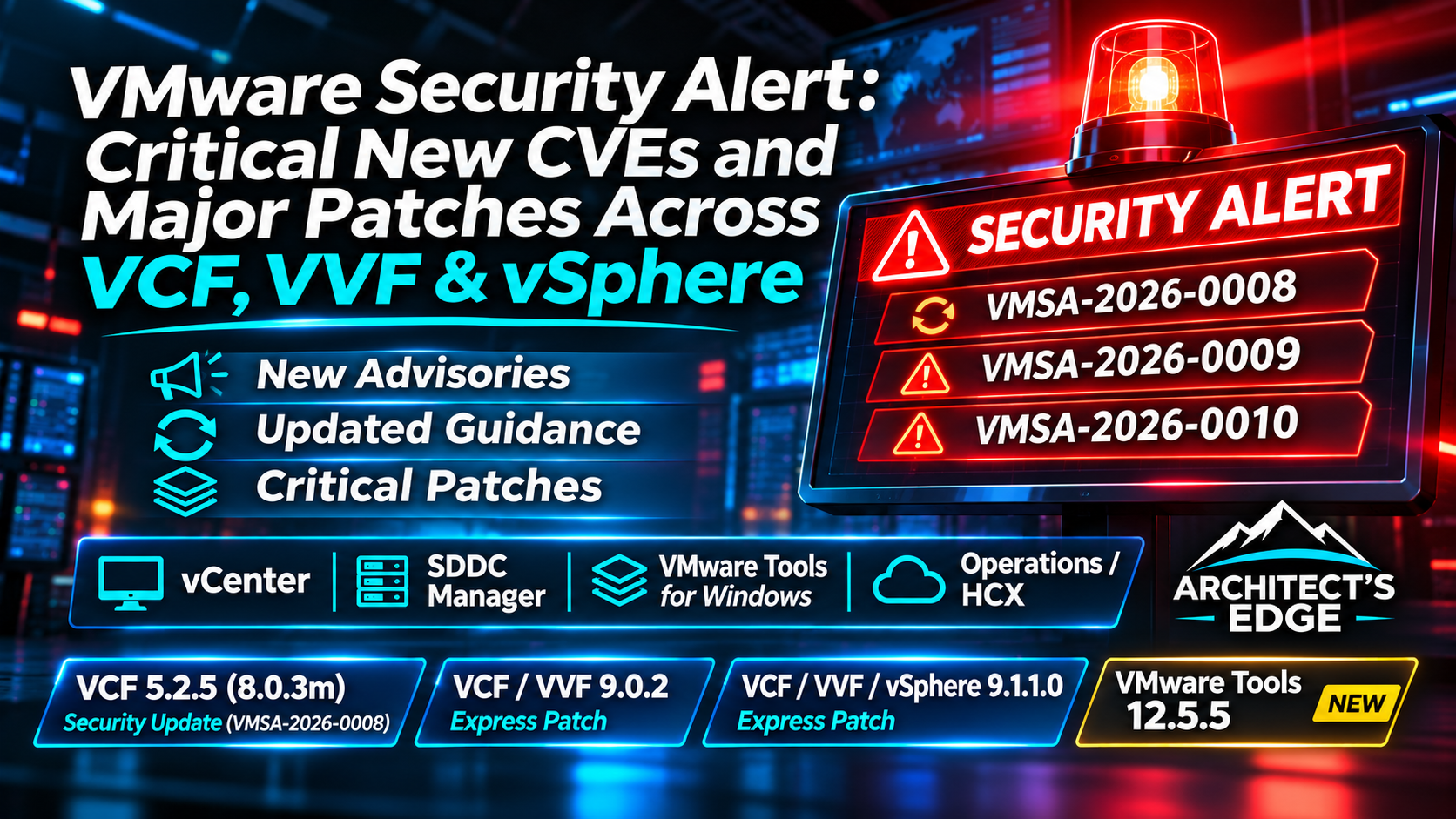
A major benefit of today’s VCF release is that VMSA-2026-0008.3 now lists VCF 9.1.2 as fixed for the critical SDDC Manager Node.js/Brotli issue on 9.1.1. VCF 5.2.5 is also fixed; 9.0.x and 9.1.0 are still pending (7.5). Keep the relevant KB460734 mitigation where applicable and follow Broadcom’s instructions for retiring workarounds. Our Node2Shell coverage explains the dependency risk in more detail.
VMSA-2026-0009 contains separate vCenter, SDDC Manager and Tools vulnerabilities. For those who remain on 9.0.x, the SDDC Manager target for 0009 is 9.0.2.0100, not the ESX or vCenter express patch. The 9.1.x SDDC Manager fix listed in the FAQ for 0009 is 9.1.1.0200, with 5.2.5 for 5.x. Track the cumulative targets when upgrading, but do not confuse the affected components.
VMSA-2026-0010 is still open for affected Operations, Aria Operations and Operations HCX versions; the fixed-version rows remain pending. Use KB463005 or KB463022 as appropriate. KB463005 also cautions that upgrades can restore the original Apache configuration and re-enable HTTP/2. Recheck affected Operations nodes after an upgrade and reapply the documented mitigation if still required. The 0011 FAQ’s statement that Operations and Automation are outside this advisory’s scope does not negate the separate 0010 exposure. VCF Networking (NSX) is not affected by 0011 according to FAQ Q20.
Make your upgrade plan before your maintenance window
Last week’s back-in-time upgrade restrictions have been addressed in VCF 9.1.2, according to FAQ Q44. Use the VCF Upgrade Planner to evaluate your specific source and target topology and review the supported component sequence. Our companion VCF 9.1.2 release analysis covers the reopened path and the new platform capabilities. Another useful reference for comparing upgrade hops and component sequencing is the independent VirtualBytes VCF Upgrade Path Advisor. Its published coverage currently ends at VCF 9.1.1, so treat it as supplemental background until it incorporates the November 24 releases; validate today’s targets against the current Broadcom advisory and interoperability matrix. For older vSphere 7 releases, consult Broadcom if you have extended support rather than assuming there is a publicly available fixed build. Telco customers should use the specific product/version instructions in KB463501.
An emergency change does not mean an improvised change. The advisory FAQ (Q34-Q37) explicitly excludes these patches from vCenter Quick Patch and ESX Live Patch. Plan for vCenter service interruption and ESX host restarts using the supported conventional update methods. A running VM receives the corrected VMX code for CVE-2026-123912 and CVE-2026-123916 when powered on or migrated with vMotion to an updated host; restarting only the guest operating system is not enough. Account for workloads that cannot migrate, including PCI passthrough configurations. Confirm backups and recovery readiness, identity and certificate dependencies, cluster capacity and evacuation options, and the order of management and host updates. Capture the initial build and target build for each component, and test management services and workload connectivity after the change. Patch installation, verified remediation and incident response are three different milestones.
If you suspect that an environment has already been compromised, do not assume that installing the fix removes an attacker’s existing access or restores trust. Engage your incident-response process, preserve relevant evidence and follow your recovery plan. A successful patch job does not retroactively establish that the environment was never exploited.
The Architect’s Edge
There is a temptation to look at a long vulnerability list and turn it into a single check box: VMware patched. The trouble is that VMware is not a single binary. Your management plane, hosts, witnesses, guests, load balancers and desktop systems each have their own lifecycle. Make the remediation register reflect that reality.
The only thing that should be stuffed this Thanksgiving is the turkey, not your patch backlog. Prioritize the critical fixes, account for what remains unresolved, and verify the work. Then, hopefully, enjoy your holiday without another surprise from the infrastructure.
Primary resources
VMSA-2026-0011 response matrix · Official FAQ · ESXi 8.x interim workaround (KB463535) · Telco guidance (KB463501) · VCF asynchronous patching (KB88287) · VCF Upgrade Planner.
Discover more from PKGuild
Subscribe to get the latest posts sent to your email.