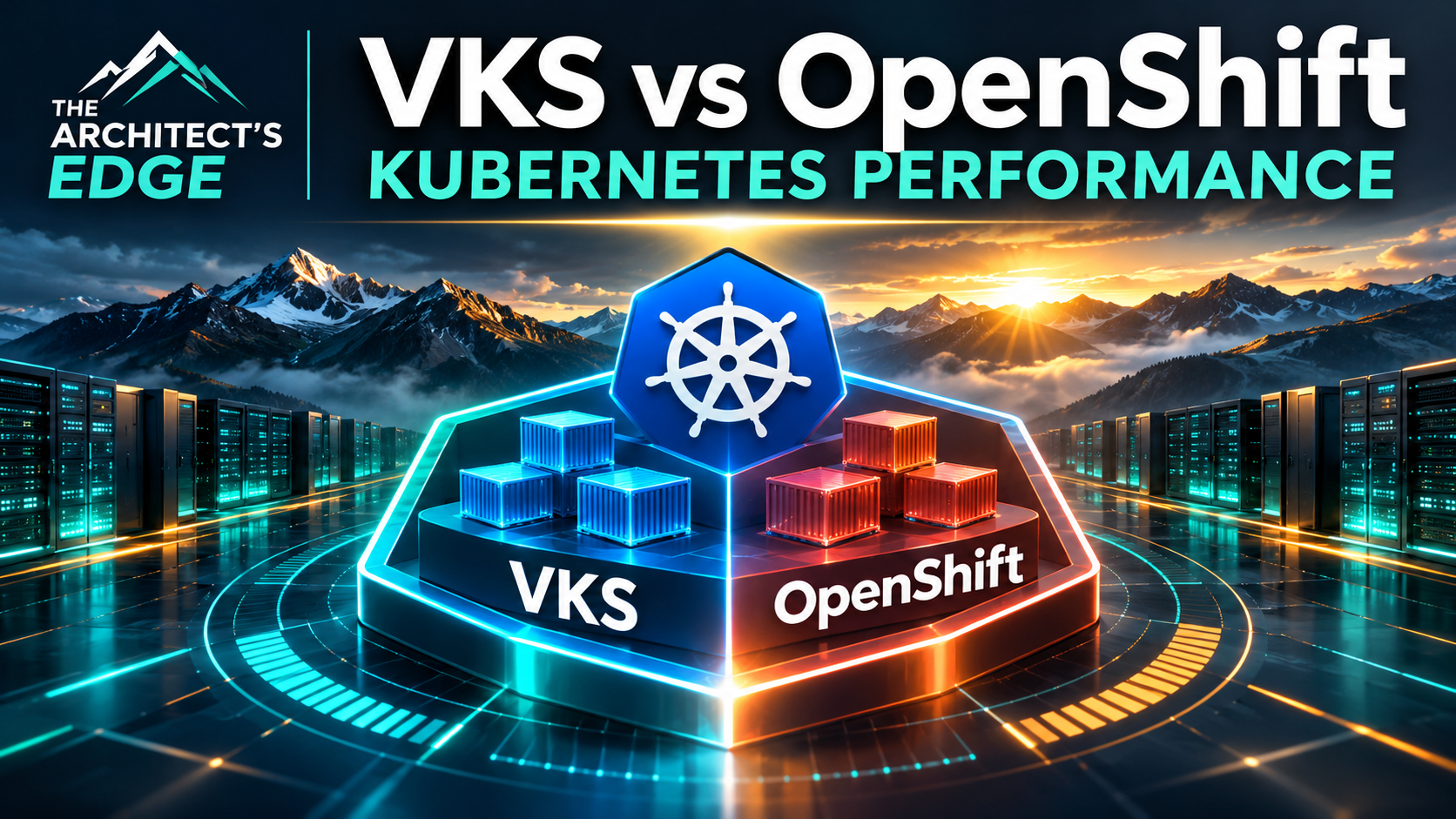
Kubernetes Performance Measured: VKS on VCF vs OpenShift
We spend a lot of time debating Kubernetes performance with opinions… and not enough time with numbers.
A new Principled Technologies (PT) study put real workloads on real infrastructure and compared three scenarios:
✅ VKS running on VMware Cloud Foundation (VCF)
✅ OpenShift running on bare metal
✅ OpenShift running on VCF (same platform foundation, different Kubernetes)
📌 If you want the raw charts + methodology, here are the papers (bookmark these):
Performance Report (chart-forward, fast read): https://www.principledtechnologies.com/Broadcom/vSphere-Kubernetes-Service-competitive-0126.pdf
Science Behind (full methodology + configs): https://www.principledtechnologies.com/Broadcom/vSphere-Kubernetes-Service-competitive-science-0126.pdf
Why this matters (even if you never read a benchmark)
Most “Kubernetes performance” conversations fall apart because they don’t answer the two questions architects actually get held accountable for:
- What happens under load and scale?
- What happens to latency when the system is stressed?
This study focuses on two workload types that show up everywhere in modern platforms:
🚀 Kafka (throughput + latency under scale)
🗂 PostgreSQL OLTP (HammerDB TPROC-C: throughput + latency)
The results you can reuse in a meeting
Kafka (this is where platforms get exposed)
Compared to OpenShift on bare metal, VKS on VCF delivered:
- Up to 73% higher throughput
- Up to 78% lower latency
If you want a concrete example to cite:
- 8 topics: ~1,450 MB/s (VKS on VCF) vs ~834 MB/s (OpenShift bare metal)
Latency snapshots that show the “shape” of the curve as load increases:
- 4 topics: ~8.24 ms vs ~39.00 ms
- 6 topics: ~22.51 ms vs ~79.62 ms
PT also references a 50 ms “acceptable latency” line:
- VKS on VCF stayed under 50 ms through 6 topics
- OpenShift on bare metal stayed under 50 ms through 4 topics
📌 The takeaway isn’t “we won a benchmark.” It’s this: VKS on VCF preserved healthier latency behavior deeper into scale.
PostgreSQL OLTP (the enterprise relevance test)
Compared to OpenShift on bare metal, VKS on VCF delivered:
- ~80% more OLTP throughput (NOPM)
- ~72% lower latency
Concrete values from the study:
- Throughput (NOPM): 112,947 (VKS on VCF) vs 62,459 (OpenShift bare metal)
- Latency: 18.33 ms (VKS on VCF) vs 66.57 ms (OpenShift bare metal)
📌 If your Kubernetes platform needs to run more than stateless apps, this is the stuff that maps directly to user experience, SLO risk, and headroom.
The third scenario is the hidden headline
A lot of teams still assume:
“Bare metal is always faster.”
That’s exactly why PT including OpenShift on VCF matters.
In these tests, PT observed:
✅ OpenShift on VCF outperformed OpenShift on bare metal
✅ And VKS on VCF still led overall versus OpenShift
📌 The clean architecture takeaway: VCF can be a strong foundation for Kubernetes performance — and VKS on VCF was the top performer in these workload tests.
How to use this immediately (without turning it into a slide deck)
If you’re evaluating platforms or planning a PoC, steal the pattern:
✅ Kafka PoC
- scale topics/producers (contention)
- measure throughput + latency
- define an “acceptable latency” threshold before testing
✅ OLTP PoC
- run concurrency (HammerDB-style or your equivalent)
- measure throughput + latency
- validate behavior under sustained load, not just burst
The report gives you the outcomes. The science behind doc gives you the blueprint.
Links + disclosure
Performance Report: https://www.principledtechnologies.com/Broadcom/vSphere-Kubernetes-Service-competitive-0126.pdf
Science Behind: https://www.principledtechnologies.com/Broadcom/vSphere-Kubernetes-Service-competitive-science-0126.pdf
Disclosure: the PT study was commissioned by Broadcom (stated in the PT documentation).
💬 Have questions about your path to VCF 9 or using VKS on VCF? Drop them in the comments or message me—we’re all navigating this together.
🔄 Like, repost, or tag someone planning their next platform move.
This article is part of the Architect’s Edge Insights series — designed to cut through confusion and deliver clarity on VMware Cloud Foundation. Stay tuned for upcoming posts as we continue to simplify VCF adoption, operations, and optimization.
#Kubernetes #PlatformEngineering #CloudNative #Containers #VMwareCloudFoundation #VCF #VKS #vSphere #PrivateCloud #Kafka #PostgreSQL #DatabasePerformance #DataStreaming #CloudArchitecture #EnterpriseArchitecture
Originally published on LinkedIn on January 10, 2026. Benchmark results and context are presented as published at the time.