The Vulnerability You Didn’t Know You Were Running: Node2Shell’s Hidden Reach
Security analysis | CVE-2026-111497 | October 31, 2026
The 60-second security briefing
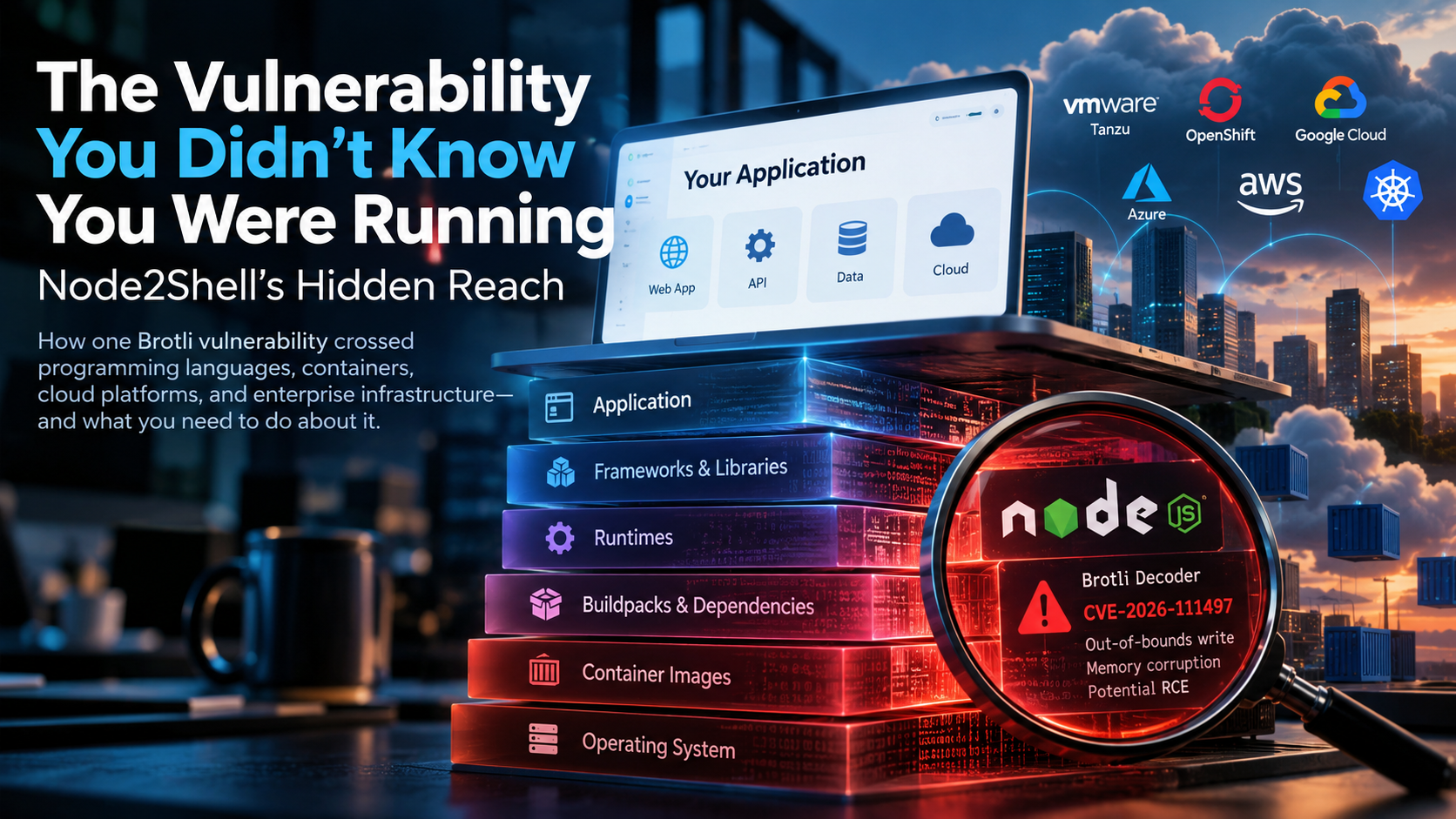
Node2Shell is not just a Node.js application problem. CVE-2026-111497 is an out-of-bounds write in the Google Brotli decoder. Affected code can be embedded in language runtimes, buildpacks, container images, packages and enterprise appliances. Whether a given product is exploitable depends on its version, code path and exposure to untrusted compressed input.
- Known exploitation: CISA added the underlying CVE to its Known Exploited Vulnerabilities catalog on October 27, 2026. This does not establish exploitation of every downstream product.
- Different products, different risks: Vendor assessments, supported fixes and mitigation instructions vary; do not extrapolate one vendor’s CVSS score or fix to another.
- A platform update is not necessarily an application fix: embedded and statically linked dependencies may require new builds, images or application restaging.
- Critical upgrade warning: An upgrade that does not fix this CVE can remove or overwrite an interim workaround, potentially re-exposing a previously mitigated system. Before upgrading, verify that the destination release actually fixes CVE-2026-111497, check whether the existing mitigation persists, and reapply or replace it according to the vendor’s documented procedure. Never mix manual and scripted mitigation/rollback methods without vendor guidance.
- Immediate action: inventory vulnerable copies; prioritize untrusted-input paths; apply product-specific vendor guidance; rebuild/restage/redeploy where required; verify the running workload.
The vulnerability at a glance
| Question | What matters |
|---|---|
| What? | CVE-2026-111497: out-of-bounds write in Google Brotli decoder |
| Impact? | Memory corruption, denial of service and potentially code execution, depending on the product and execution context |
| Where? | System libraries, bundled runtimes, containers, buildpacks, embedded software |
| Is it exploited? | Underlying CVE appears in CISA KEV; product-specific exploitation must be assessed separately |
| What’s the fix? | Vendor-specific update or mitigation; sometimes rebuild, restage, redeploy or restart |
The surprising part: your application may not use Node.js
A Ruby or .NET application can still be packaged or staged using tools that contain a Node.js binary. Scanners may correctly identify vulnerable bytes inside a buildpack or archive without establishing that the binary executes in a running application, or that attacker-controlled Brotli input can reach it. Conversely, an old runtime inside a deployed artifact can persist after the shared platform has been updated.
Presence, reachability, exploitability, remediation and verification are five different questions. A good assessment answers all five rather than treating a scanner result as a complete risk determination.
Where teams should look
| Environment | Investigate | Action |
|---|---|---|
| Node.js applications | Bundled decoder in deployed runtime | Upgrade to vendor-fixed supported release; verify runtime |
| Python and .NET | Brotli bindings; system vs bundled libraries | Apply package/runtime-specific advisories; rebuild as necessary |
| Tanzu / Cloud Foundry | Buildpacks, staged droplets, images, platform components | Update affected buildpacks and restage applications per Broadcom guidance |
| Red Hat / OpenShift | Affected OS packages, images, runtime linking | Follow Red Hat errata and replace affected workloads |
| GKE / AKS / EKS | Customer-managed container images and dependencies | Remediate workloads; separately consult cloud-provider advisories for managed services |
| VCF SDDC Manager | Version-specific appliance exposure | Use Broadcom’s official interim mitigation until an applicable product fix is released |
Listing GKE, AKS or EKS here does not mean their managed control planes are vulnerable. The focus is on customer-deployed workloads and verified provider advisories.
What the official vendor evidence shows
Broadcom: SDDC Manager and Tanzu require different responses
VMSA-2026-0008.1 lists VMware Cloud Foundation SDDC Manager 9.1.1 as Critical (9.8), and affected older SDDC Manager release families as Important (7.5). Its revised response matrix identifies VCF, not VVF. Removal of VVF from the matrix does not prove every VVF component is unaffected. Broadcom’s KB 460732 (SDDC Manager 9.1.1.x) and KB 460734 (older affected SDDC Manager releases) document distinct interim mitigations; product patches remained pending at this research cutoff.
Do not let a routine upgrade silently undo a mitigation. A destination version that has not fixed the underlying vulnerability may require reapplication of the workaround. Follow the correct version-specific check, apply and rollback procedure, and verify mitigation after maintenance.
For the complete version matrix, procedures and updates, see our dedicated SDDC Manager technical advisory.
Broadcom’s Tanzu advisory (KB 460898) documents corrected buildpacks and other components. For affected applications, installing a newer buildpack is not the end of remediation: teams must ensure applications have been restaged or rebuilt so the running artifact incorporates the corrected runtime.
Red Hat: linkage changes the remediation path
Red Hat’s CVE assessment illustrates that runtime and distribution combinations may use either bundled or system Brotli. A system-library update may address some deployments, while others require updated runtimes or application rebuilds. Verify the precise supported package and deployment model.
Other platforms: distinguish managed services from workloads
Kubernetes orchestrates containers; it does not automatically replace vulnerable libraries in customer-built images. For OpenShift, GKE, AKS, EKS and other platforms, check both applicable official platform advisories and the dependencies in deployed workloads. Do not infer a managed control-plane vulnerability from a vulnerable application image.
Remediation decision table
| Finding | Likely action | Proof of completion |
|---|---|---|
| System Brotli package | Vendor update and affected process restart | Updated package and live process verified |
| Bundled Node.js runtime | Replace with fixed supported runtime | Runtime version inside deployed artifact |
| Statically linked decoder | Rebuild or replace binary | Corrected binary deployed |
| Container image | Rebuild and redeploy | New image digest running |
| Cloud Foundry buildpack | Update buildpack; restage affected apps | New droplet and instances verified |
| Enterprise appliance | Official product-specific patch or mitigation | Vendor validation and post-upgrade check |
| Scanner-only match | Validate binary, use and reachability | Evidence-backed risk disposition |
Five questions to ask before closing a finding
- Present: Is the vulnerable component in the deployed software?
- Reachable: Can untrusted data reach the affected decoder?
- Exploitable: What does the vendor’s product-specific assessment establish?
- Remediated: Did the running artifact receive the fix, or only the platform/build tooling?
- Verified: Have we confirmed the effective version, mitigation and post-maintenance state?
What CISOs should ask this week
Request a prioritized list of externally exposed or untrusted-input-processing workloads, the distinction between confirmed exposure and dependency-only matches, the number of available fixes not yet deployed, interim mitigations at risk of being lost during upgrades, and owners for unresolved vendor assessments. Require evidence of remediation in running workloads—not simply a closed ticket.
The architectural lesson
A scanner can tell you where to look. Architecture and evidence tell you what a finding means. A patched platform does not automatically mean a patched application, and an unrelated upgrade can undo an interim protection. Inventory, assess reachability, apply the supported fix, and verify the result after every relevant change.
Go deeper: technical remediation and component evidence
For detailed runtime and buildpack analysis, a cross-vendor affected-product matrix, remediation mechanics, and verification steps, read our companion Node2Shell Under the Hood: Hidden Dependencies, Affected Runtimes, and Fixes That Actually Work. This technical companion includes publicly documented Broadcom, Red Hat, and cloud workload considerations.
Primary references
- NIST NVD CVE-2026-111497
- CISA Known Exploited Vulnerabilities catalog
- Broadcom VMSA-2026-0008
- Broadcom KB 460732 and KB 460734
- Broadcom Tanzu KB 460898
- Red Hat CVE assessment
- Broccoli2Shell research index (community source)
Research cutoff: October 31, 2026. This article uses public findings; confirm current official advisories before production changes. Community research is a discovery aid, not a substitute for vendor-supported remediation.